下面的表格清晰地展示了主要类型的特点:
| Andamento 类型 | 嵌片特点 (精细度/规整度) | 排列规则与视觉流 | 典型应用 |
|---|---|---|---|
| Opus Tesselatum | 中等 / 高规整度 | 规则的水平或网格状排列。这是最基础的“直叙”语法,构成背景或大面积色块 -4。 | 大规模地板、背景填充 |
| Opus Vermiculatum | 精细 / 高规整度 | “虫迹状”排列。嵌片沿着主体形象的轮廓紧密排列,形成一圈醒目的线条,就像给人物或物体描边,能使其从背景中“跳”出来 -4。 | 人物轮廓、重要细节的强调 |
| Opus Musivum | 中等 / 高规整度 | “层叠曲线”排列。嵌片以平行的曲线形式排列,层层递进,填充背景,营造出流动、扩展的空间感 -4。 | 大型背景、天空、水域 |
| Opus Classicum | 混合 | 这是一种混合语法。主体使用精细的 Opus Vermiculatum,而背景则使用规整的 Opus Tesselatum,通过对比突出主体 -4。 | 复杂的叙事场景、神话故事 |
| Opus Palladianum | 低 / 低规整度 | “狂野不羁”的排列。使用形状、大小各异的 irregular 嵌片,无固定流向地铺砌,形成类似抽象画般的破碎、闪烁效果 -4。 | 特定风格的装饰、模仿自然岩石 |
| Opus Sectile | 极高 / 低规整度 | “大理石拼花”语法。不使用大量小嵌片,而是用大块石材精确切割成所需形状(如花瓣、叶片),直接拼出图案 -4。 | 奢华的墙面板、复杂的几何图案 |
Mosaic Stylization Using Andamento – Seoul National University of Science & Technology
The layout or design of a mosaic, which is first decided through a mosaic creation process, is called Andamento. Andamento is a Latin word that refers to the flow or movement of tiles and is classified according to the characteristics and positions of the tiles, as shown in Fig. 1.
Opus Tesselatum: The tiles are laid along regular horizontal lines like bricks.
Opus Classicum: Opus Tesselatum is used as the background.
Opus Vermiculatum: An outline technique for achieving a halo effect.
Opus Musivum: A repeated outline background is used.
Opus Palladianum: Tiles with an irregular shape are laid irregularly.
Opus Sectile: Complete shaped tiles are used instead of lots of individual tiles.
目前并没有特别理想的全自动生成器。
还得搞手工创作工具
Artistic tessellations by growing curves
3 Tessellations by Growing Curves
Instead of thinking of tessellation as packing individual primitivesinto a region, we could build a tessellation by filling a region withcurves. The curves themselves are the tile boundaries. We describeour tessellation as follows.Process 1. Given a region and a direction field, and also givena starting point or a starting distribution, a tessellation is formedby the growth of a set of curves, growing either sequentially or inparallel. Each curve grows until it stops either by reaching another curve intersection or the region boundary. If the length of a curve istoo short or the curve passes too close to previous curves, the curveis removed.
The adjustments for the initial starting assignment, the order of thegrowth, the orientation of the growth, and the properties of thecurves (such as curvature, arc length, and thickness) control thefinal effects of the partition. We strive to create tessellations thathave good visual quality. Wong et al. [1998] demonstrated thatrepetition, balance, and conformance to geometric constraints arethree elements to the perception of order. We take their advice andwe also intend to introduce irregularities and randomness into thepartition to make our simulation appear natural. The following aresome general principles we adopt for our process
.• Curves have similar properties along their length, such as cur-vature; starting orientations are also similar. Enforcing thisproduces similar region shapes, providing a sense of unity.
• We do not allow short curves to be used and we do not allowthe spacing of two curves to be very close.
• We enforce a minimum spacing when we assign startingpoints.
• Irregularities are attained by putting some random elementsinto the curve properties and the curve starting orientation;further apparent randomness derives from the uncertainty inintersection locations.
The curve growing process can be either sequential or parallel. Inthe sequential case (S-Method), we process curves one by one: an-other curve is created when the previous one is completed. In theparallel case (P-Method), multiple curves are initialized simultane-ously and then grow incrementally in parallel.
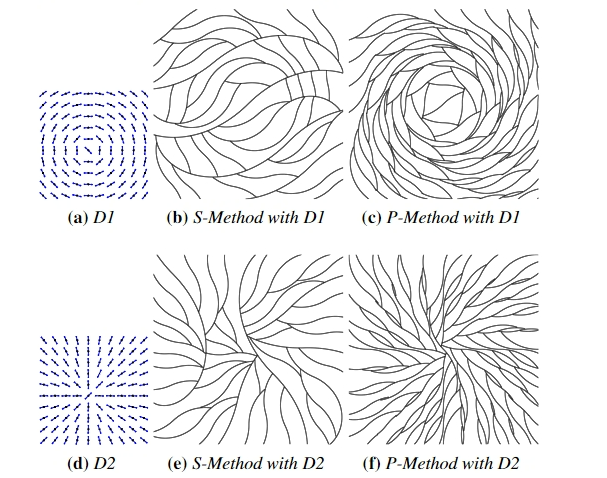
We show examples from both our sequential method and our paral-lel method in Figure 3. The tiles in those tessellations are not regu-lar, but curved and elongated. Globally, the tessellations have somesimilarities because they are using the same curve generation pro-cess and the same two direction fields. However, some differencesappear because of the order of operations. The parallel method bet-ter preserves the large-scale trend from the initial distribution, sincecurves are generally shorter and hence do not have time to varymuch from their initial direction. Spatial control is only possiblethrough the initial distribution. Conversely, the sequential method has more flexibility of spatial adjustment since logic can be appliedat each individual curve placement, taking into account all previouscurves. Doing this often makes the order of curve placement ap-parent, which is sometimes undesirable, although for some patternssuch as cracking it is a useful effect.
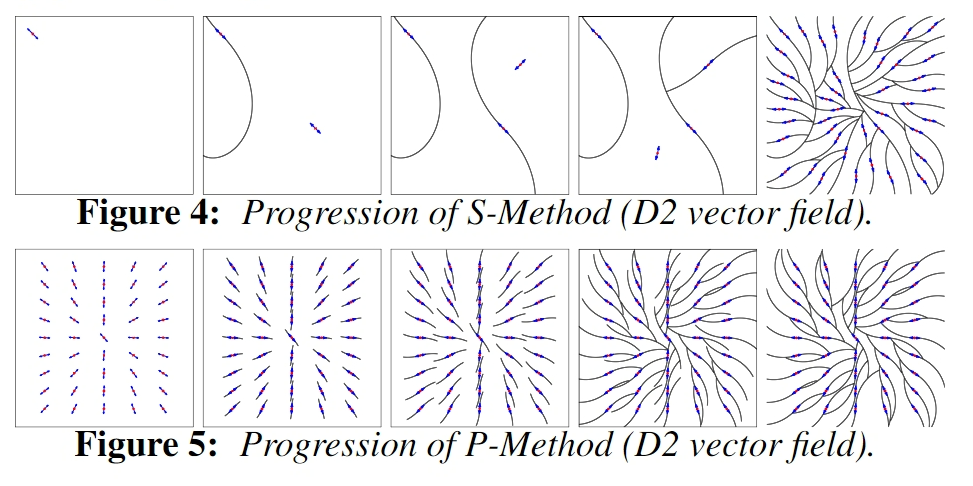
Figure 4 shows a suggested process for the S-Method. The firstcurve begins at a random point and grows in two opposite direc-tions. Next, we create and maintain a distance map, storing the dis-tance of all locations to the nearest point either on a curve or on theregion boundary. We next generate a curve beginning at the point ofmaximum distance; in this way we avoid the narrow spacing due toclose placement. The process iterates, repeatedly growing the nextcurve and updating the distance map, stopping when the maximumdistance value is below a threshold.
Figure 5 then shows an example of the P-Method. This examplebegins with a 5 × 9 grid of points. Each iteration, the curves aregrown in a fixed time step. The curve will stop its growth when itmeets with other curves or the region boundary. After all curvesstop growing, the process ends.
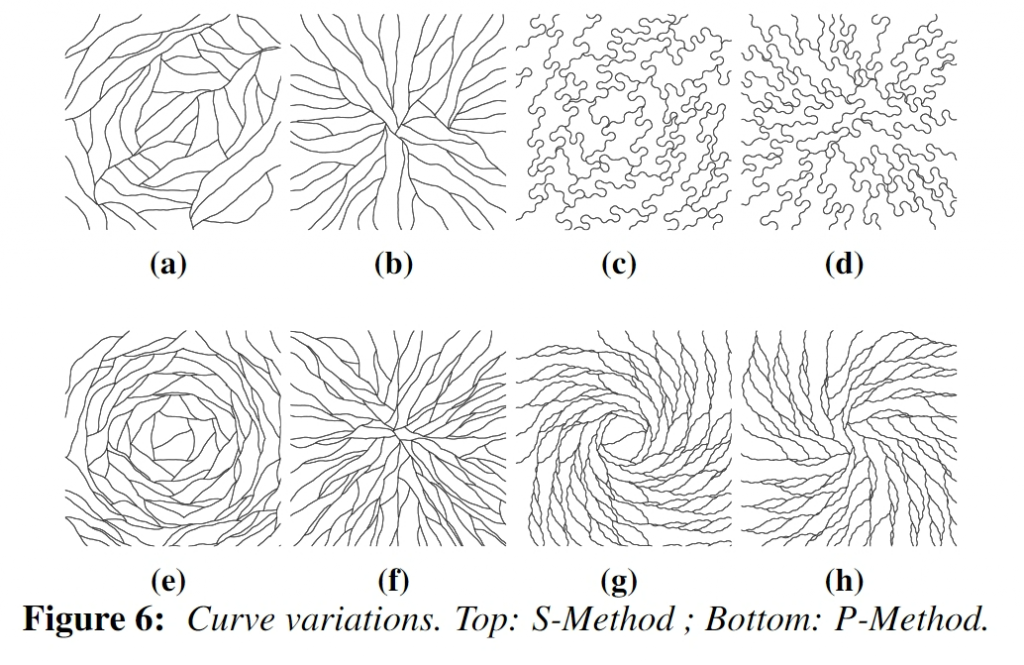
In principle, any method for curve generation can work for thisstrategy. We propose to use a particle system [Reeves 1983] as ourcurve generator in this paper. 我们使用物理模拟的实现——与前向欧拉积分相关联. Each time step (∆t = 0.01),the particle system updates a new position x from previous velocityv0 and previous position x0 based on the dynamics. The sequenceof positions constructs a curve. The key calculations are as follows:a = F/m for a force F, v = v0 + a × ∆t, x = x0 + v × ∆t, and we useunit mass m = 1. We use different force configurations for differ-ent purposes. For mosaic styles, we read −→F from a vector field; forother abstracts and natural patterns, we use the Lorentz force, previ-ously used to generate magnetic curves [Xu and Mould 2009]. Theexamples in this section were generated using magnetic curves; de-tails appear in the following sections. Figure 6 shows another groupof tessellations from the same strategy as Figure 3 but using curvevariations. They all globally maintain the same directional impres-sions as Figure 3. However, they contain further small-scale detailsdue to the variations in curve properties.